
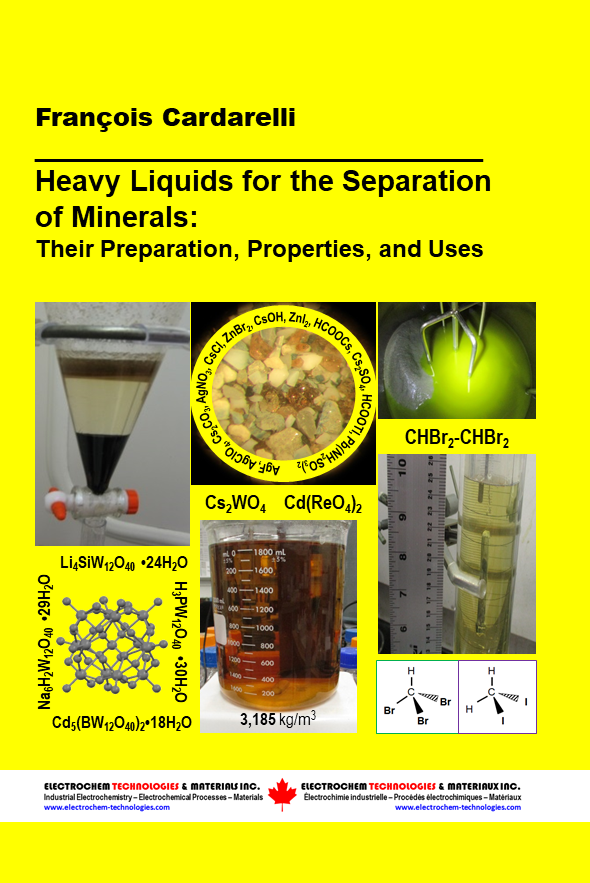
 |
Heavy Liquids for the Separation of
Minerals: Their Preparation, Properties, and Uses
Author:
François Cardarelli
Publisher:
Electrochem Technologies & Materials Inc., Montréal,
Canada
ISNI: 0000 0005 1247 3654 Pages :
xxiv, 537 pages, 285
tables, 76 figures B/W and
Color
Format: 6 inches x 9 inches (15.24 cm x 22.86 cm) Library of Congress Catalog No.: n.a. Canadian Classification Number: n.a. ISBN
978-1-7775769-6-7 Softcover
March 24, 2025
ASIN: 1777576962
ISBN 978‐1‐7775769‐7‐4
eBook
March 24, 2025
ASIN: BOF2CTCF8W
This
monograph is primarily intended to describe the main physical
and
chemical properties of heavy organic
liquids (e.g., bromoform, tetrabromoethane, diiodomethane), dense aqueous
solutions of salts of
inorganic acids
(e.g., halides, sulfates, nitrates, perchlorates, molybdates,
tungstates, metatungstates, polytungstates, polyoxometalates,
tantalates, perrhenates, etc.), and salts
of organic acids (e.g, formates, acetates, oxalates, malonates,
benzoates, salicylates, citrates, etc.) and heavy suspensions used in
mineralogy, gemology, mining, metallurgy, and chemistry for the
separation by gravity of minerals, metallic ores,
graphite, coal
macerals, fossils, diamonds and gemstones along with plastics, glass,
ceramics
and
other synthetic materials. Moreover dense solutions of cesium and
rubidium salts used in
biology
for the separation of nucleic acids, and other biological molecules of
interest
by centrifugation using density
gradients are also described. For several
heavy liquids, it provides a detailed description of the laboratory
methods,
and industrial processes utilized for their preparation along with the
most efficient
recovery and recycling techniques. Moreover, when available the
occupational
health and safety information for toxic and hazardous chemicals
used
as heavy liquids is also provided to ensure safe practices in the work
place. Finally, their potential utilization in others fields such as X-ray and radiography contrast agents, radiation shielding agents, non-destructive testing, water-in-salt electrolytes for energy storage applications, oil drilling fluids, ballasts and counterweights due to their high density are described. The information has been presented in such a form that mineralogists, chemists, geologists, paleontologists, biologists, metallurgists, mineral processing engineers, scientists, professors, and technologists will have access to relevant scientific and technical information supported by key data gathered from several disseminated sources. The
following topics are covered: •
Dense
media separation of minerals
and ores by the sink-float method, elutriation, fluidization,
centrifugation
and density gradients; •
Heavy
halogenated organic solvents; • Dense aqueous solutions of inorganic salts:
• Dense salts in non-aqueous solvents; •
Deuterated
solvents and solutions; •
Dense
molten salts and eutectics; •
Suspensions
of heavy solids; •
Liquid
metals and low melting point
alloys; •
Non-conventional
heavy liquids; •
Other
uses; •
Appendices; •
Bibliography. |


